The Three Kanji: 復, 信, 恵 — What We Carry on the Garment
Three kanji anchor Drop 001 — restoration, faith, grace. Why language worn on the body is a discipleship practice, not decoration.
A kanji is a compressed image. Centuries of meaning folded into a handful of strokes — etymological sediment, spiritual shorthand, a sentence you can hold in your hand. When you learn to read one, you do not simply decode a symbol. You unpack a philosophy.
We put three kanji on three garments. Not as decoration. Not as exoticism. As weight. Each character carries a theological argument that would take a paragraph to make in English but arrives in a single glyph on the chest. 復 — restoration. 信 — faith. 恵 — grace. These are the three anchors of Drop 001, and this essay is about why we chose them, what they contain, and what it means to carry language on your body.
We have written about kintsugi and redemption. We have written about the theology of sumi black. This is the essay about the words themselves.
復 — Restoration
The piece: Restored Hoodie — bone white, 400 GSM, $165
The scripture: 2 Corinthians 4:7
The character 復 is a phono-semantic compound — a kanji whose meaning lives partly in its structure. On the left stands the radical 彳, which means “step” or “to walk.” On the right sits 复, an older character meaning “to return” or “to repeat,” built from components that oracle bone script scholars trace to an apparatus flipped back and forth to measure grain, and a backward-facing foot. The combination is precise: 復 is a return-walk. A stepping-back-to-where-you-were. Not retreat — restoration. 回復 (kaifuku) means recovery. 修復 (shūfuku) means repair. 復活 (fukkatsu) means revival, resurrection.
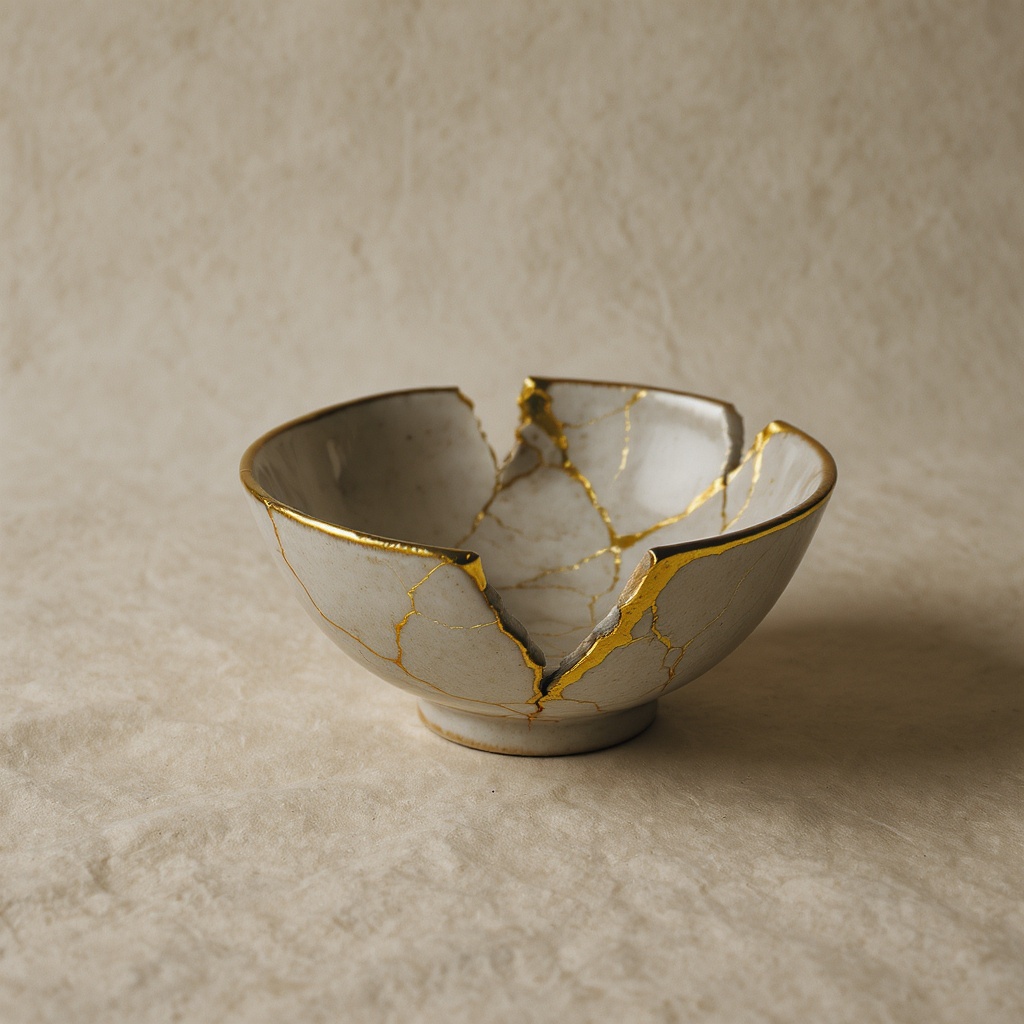
This is what Paul is talking about in his second letter to Corinth — though he had no Japanese, and no kanji. He had Greek: θησαυρὸν ἐν ὀστρακίνοις σκεύεσιν — treasure in earthen vessels. Jars of clay. The metaphor is kintsugi before kintsugi existed. We carry something immeasurably valuable in something immeasurably fragile. The power, Paul insists, belongs to God — not to the vessel. The vessel cracks. The vessel always cracks. That is the point. The restoration — the 復 — does not come from the clay’s own strength. It comes from what was poured into the clay after the breaking.
The Restored Hoodie is bone white. Not pristine white — bone white. The white of something that has been through the fire and come out the other side. The color of a vessel that was broken and mended. The kanji sits on the chest like a thesis: I have been restored. Not by my own hand. By the hand that fills the crack with gold.
The return-walk of 復 is not circular. You do not end up where you started. You end up somewhere that could not have existed without the breaking and the walking back. That is restoration — not repetition, but resurrection with the scars still visible.
“The return-walk of 復 is not circular. You end up somewhere that could not have existed without the breaking and the walking back.”
信 — Faith
The piece: Gold Seam Tee — sumi black, 280 GSM, $85
The scripture: Isaiah 61:3
The character 信 is constructed from two elements that form a single argument. On the left: 人 (亻 in its radical form) — person. On the right: 言 — word, speech, to say. A person who stands by their word. That is the entire character. That is faith.
Not feeling. Not warmth. Not the soft assurance that everything will be fine. Faith, in the structural logic of this kanji, is a character issue. It is what a person does with their mouth and their feet. 信 does not describe an internal state. It describes a posture — the posture of someone whose word and whose presence are aligned. Shin — honesty, sincerity, fidelity, trust. The Japanese proverb 信じる者は救われる — “the one who believes will be saved” — uses this kanji. The earliest forms of 信, traced to bronze-age Chinese script, may have combined 言 (word) with 心 (heart) rather than 人 (person) — “to speak from the heart.” Either way, the architecture is the same: faith is not passive. It is a declaration.
Isaiah 61:3 promises a crown of beauty instead of ashes — the oil of joy instead of mourning, and a garment of praise instead of a spirit of despair. The Hebrew context is exilic. The Israelites are captive, broken, covered in the ash of everything they have lost. Into that ash, the prophet speaks a reversal so absolute it reads like poetry — because it is poetry. Beauty for ashes. Joy for mourning. Praise for despair.
The Gold Seam Tee carries 信 in gold on sumi black. We wrote about sumi in the previous essay — how it is made from pine soot, how monks ground it in silence as preparation for prayer, how it became the ground that makes grace visible. The gold kanji on that sumi-black field is Isaiah’s promise made wearable. Not faith as a feeling — faith as a commitment made visible against the darkest ground you own. The person standing by their word, even when the word is spoken into ash.
“Faith is not passive. It is a declaration — a person standing by their word.”
恵 — Grace
The piece: Mended Vessel Crewneck — bone white, 380 GSM, $135
The scripture: Romans 8:28
The character 恵 is a simplification of the older form 惠. At the bottom sits the radical 心 — heart. In Japanese kanji classification, 心 (kokoro) is Radical 61, the marker of emotion, intention, inner life. Every kanji built on this radical touches something felt — 悪 (evil), 愛 (love), 悲 (grief), 感 (feeling). The top component has been interpreted various ways across centuries of scholarship — a spindle, a weight, the act of concentrating or turning toward. What matters is the composite meaning: the heart turned toward another. To give with heart. To bestow. 恵む (megumu) — to bless, to favor. 恩恵 (onkei) — grace, blessing.
Grace, in this kanji, is not a transaction. It is a posture. The heart does not turn toward the deserving — it turns toward the other, whoever the other is, without condition. That is the radical claim of the character: grace is an orientation, not a reward.
Paul’s letter to the Romans makes this explicit. Chapter 8, verse 28: “And we know that for those who love God all things work together for good, for those who are called according to his purpose.” The Greek verb is συνεργεῖ — synergei — from which we get “synergy.” It does not say that things are individually good. It says that they cooperate. They work together. They are gathered — the beautiful and the brutal — and in the gathering, something emerges that could not have existed if any single element had been removed.
The Mended Vessel Crewneck carries 恵 in a quiet declaration. The bone-white garment, like the Restored Hoodie, evokes the vessel — the jar of clay, the mended bowl. But where 復 speaks of the act of returning, 恵 speaks of the reason. Grace is why the vessel gets mended at all. Not because the clay earned it. Not because the break was small enough to fix. Because the heart of the mender turned toward the broken thing and chose to make it whole.
What You Wear Shapes What You Mean
There is a long tradition — longer than fashion, longer than branding — of carrying language on the body. Jewish tefillin bind scripture to the forehead and the arm. Buddhist prayer flags carry mantras into the wind. The monks who practiced bokuseki — traces of ink — understood that the words they brushed onto paper were not separate from the body that moved the brush. The word and the body were continuous.
We are not claiming that a tee shirt is tefillin. But we are saying that what you put on your chest is not neutral. A slogan is a slogan. A logo is a logo. A kanji — chosen deliberately, placed with intention, connected to a theology of brokenness and repair — is something closer to a catechism. It teaches you what you mean every time you reach for it in the morning.
復 — you have been restored, and the restoration is ongoing.
信 — faith is what you do with your word and your body, not what you feel.
恵 — grace is the heart that turns toward you before you ask.
Three garments. Three characters. Three sentences compressed into three strokes of ink — or three threads of gold on fabric that sits against the skin. This is what Kinshin is: language worn on the body as a practice of remembering. Not aesthetic. Discipleship.
See the full collection at kinshin.onrender.com/shop. Or start with the lookbook.
The seam is the story.
Wear the seam — Drop 001 →
Restored Hoodie · Gold Seam Tee · Mended Vessel Crewneck. Made to order. Ships in 2–3 weeks.