Sumi Black: The Theology of a Color
Why we chose sumi black for the Gold Seam Tee. From pine-soot ink to the theology of darkness, the color that makes grace visible.
Before there was a brand, there was a color.
We chose sumi black for the Gold Seam Tee before we chose the cut, before we sourced the blank, before we settled on the kanji. The 280-gram Comfort Colors 1717 in black was the starting point for everything. Not because black is safe. Not because it sells. Because sumi — the particular black we had in mind — carries a thousand years of meaning in its soot, and we wanted that meaning against the skin.
This is the story of that color. Where it comes from, what it holds, and why it matters that the gold seam sits on top of it.
I. Pine Soot and Patience
Sumi (墨) is the Japanese word for ink — specifically, the solid ink stick used in calligraphy and brush painting for over a millennium. Its recipe is almost absurdly simple: soot from burned pine branches, bound with nikawa (animal-hide glue), sometimes scented with camphor or musk. The mixture is kneaded while warm, pressed into wooden molds, and then dried — slowly — for six months to a year. Some premium sticks from Nara, where ninety-five percent of Japan's sumi is still produced by hand, take even longer.
The oldest surviving manufacturer is Kobaien, founded in 1577 in Nara. A single 200-gram ink stick from their workshop can cost over a thousand dollars. Not because of rare materials. Because of time, and the refusal to rush it.
Sumi is one of the Four Treasures of the Study (文房四宝) — brush, ink, paper, inkstone — a concept that originated in China during the Southern and Northern Dynasties (420–589 AD) and traveled east with Buddhism. In Japan, these four tools became inseparable from the practice of shodō (書道), the way of writing. But the ink was always more than a medium. It was a discipline.
To use sumi, you grind the stick against a wet inkstone, slowly, adding water drop by drop. The friction releases the soot into liquid. Less water produces a deeper, heavier black. More water yields something closer to smoke. The calligrapher controls the density of meaning with the pressure of their hand and the patience of their grinding.
And this is where the ink becomes theology.
II. The Void Mind
Zen Buddhist monks adopted calligraphy as a spiritual exercise centuries ago. Their practice — called bokuseki (墨蹟), literally "traces of ink" — was never about penmanship. It was about presence. The monk enters a state of mushin (無心), translated as "no-mind" or "void heart": a consciousness swept clean of distraction, calculation, ego. In that emptied state, the brush moves. The ink meets the paper. What emerges is not writing in the conventional sense but a record of a moment of complete attention.
The great Zen calligraphers — Hakuin Ekaku (1686–1768), Sengai Gibon (1750–1837) — were not professional scribes. Their lines were often messy by academic standards. That was the point. Bokuseki privileges expression over legibility, spirit over form. A single ensō (the Zen circle painted in one breath) can encode decades of practice in what appears to be a casual gesture. The ink doesn't lie. It records the tremor, the speed, the commitment.
Japanese calligraphy treats the grinding of sumi as meditative preparation — the slow, repetitive motion is not idle time before the real work. It is the real work. At Yakushiji Temple in Nara, visitors still practice shakyo (写経), copying sutras in sumi ink, as a form of moving meditation. The monk-calligrapher does not simply use the ink. They enter it. The blackness becomes a field of attention, a cleared ground where something can appear.
For Kinshin, that resonated. We are not a Zen brand. We are a faith brand rooted in the Christian tradition of brokenness and repair. But the sumi-black discipline of clearing the ground — making space for what comes next — spoke directly to what we were trying to build.
"The blackness becomes a field of attention, a cleared ground where something can appear."
III. Treasures of Darkness
Western Christianity has an uneasy relationship with the dark. We default to a clean binary: light good, dark bad. God is light; sin is shadow. But that's not quite what Scripture says.
"Even the darkness is not dark to you," David writes in Psalm 139:12. "The night is bright as the day, for darkness is as light with you." This is not a reluctant concession. It is a declaration: God does not need our light to see. Darkness does not diminish his presence. It does not even slow him down.
Isaiah 45:3 pushes further: "I will give you the treasures of darkness and the hoards in secret places, that you may know that it is I, the Lord, the God of Israel, who call you by your name." The context is geopolitical — God is addressing Cyrus, the Persian king who would liberate Israel from Babylonian exile. But the spiritual resonance is unmistakable. There are things God hides in the dark. Not because he is withholding them, but because they can only be found there. Some blessings require the dark to ripen. Some truths are only visible when everything else has been stripped away.
The medieval Christian mystics understood this instinctively. The anonymous fourteenth-century English author of The Cloud of Unknowing described a "cloud" standing between the soul and God — not as an obstacle, but as the necessary condition for a kind of knowing that transcends intellect. You cannot think your way to God, the author argued. You must love your way into the darkness, surrendering concepts and images, resting in a "naked intent" directed toward the divine. The cloud is not absence. It is the womb of presence.
Two centuries later, the Spanish Carmelite friar John of the Cross named the soul's most painful and productive season La Noche Oscura — the Dark Night. In his framework, God's infinite light is so far beyond human capacity that it registers as darkness to our natural perception, the way staring at the sun blinds rather than illuminates. The dark night is not abandonment. It is encounter — an encounter so overwhelming that the soul's ordinary instruments of perception shut down. What feels like God leaving is actually God arriving in a form we are not yet equipped to hold.
"The more clear and self-evident Divine things are," John wrote, "the more obscure and hidden they are to the soul naturally."
This is the theological lineage we claim when we dye a tee shirt sumi black.
IV. The Ground That Makes Grace Visible
Here is the practical insight that connects a thousand years of ink-making to a piece of streetwear:
Gold needs black to be visible.
If you lay a gold seam on a white garment — and we did, on the Restored Hoodie — it reads as warmth, as sunlight, as gentle restoration. Beautiful. True. But the gold seam on sumi black reads differently. On black, gold is not warm. It is electric. It cuts. It announces itself against the void the way a crack of light announces itself under a closed door. The fracture becomes impossible to ignore.
This is the kintsugi principle made wearable. In the Japanese art of repairing broken pottery with gold lacquer, the dark glaze of the original vessel is what gives the gold its drama. Without the dark ground, the gold seam is decorative. With it, the gold seam is a thesis: the break was not the end of the story.
We wrote about this in our first essay. The gold is grace. The crack is the fracture — the failure, the loss, the thing you thought disqualified you. But grace needs a surface to adhere to. It needs the evidence of what broke. And it needs contrast to be seen.
Sumi black is that contrast.
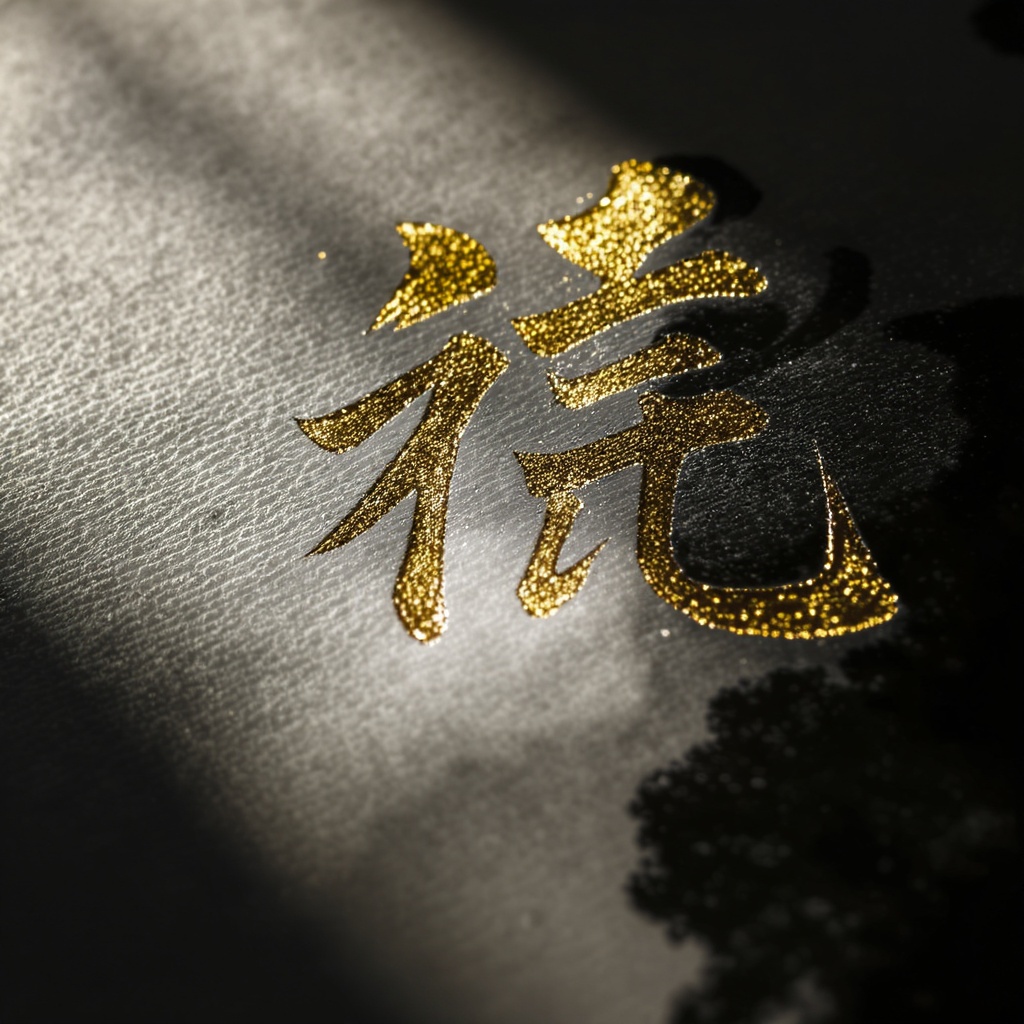
The kanji on the Gold Seam Tee is 信 — shin, faith. It sits in gold on sumi black. Not faith as a feeling. Faith as a commitment made visible against the darkest ground you own. Isaiah 61:3 promises "beauty for ashes." Sumi is made from ashes — literally, from soot. And the gold seam turns those ashes into something you can wear.
"The kanji on the Gold Seam Tee is 信 — shin, faith. It sits in gold on sumi black. Not faith as a feeling. Faith as a commitment made visible against the darkest ground you own."
V. What You Carry
When you put on the Gold Seam Tee, you are wearing sumi — a color that monks ground in silence as preparation for prayer, that calligraphers treated as a form of meditation, that an anonymous English mystic called the cloud where God hides. You are wearing the theological tradition that says darkness is not the enemy of faith but its necessary ground. You are wearing the color that makes the gold seam legible.
We did not choose black because it matches everything. We chose it because it means everything — when you know where to look.
The gold seam is the headline. Sumi black is the sermon.
Explore the collection at kinshin.onrender.com/shop. Not ready to buy? Join the waitlist and we'll let you know what's coming.
The seam is the story.
Wear the seam — Drop 001 →
Restored Hoodie · Gold Seam Tee · Mended Vessel Crewneck. Made to order. Ships in 2–3 weeks.