Why Kintsugi
The origin story of kintsugi, the theology of the jar of clay, and why Drop 001 is a wearable confession about the value of the crack.
In the 15th century, the Japanese shogun Ashikaga Yoshimasa broke his tea bowl. It was a beautiful thing — imported from China, the kind of object that communicated taste, wealth, a certain kind of cultivation. When it cracked, Yoshimasa sent it back to China to be repaired. The Chinese craftsmen did what craftsmen did: they put metal staples across the crack. Functional. Durable. Ugly.
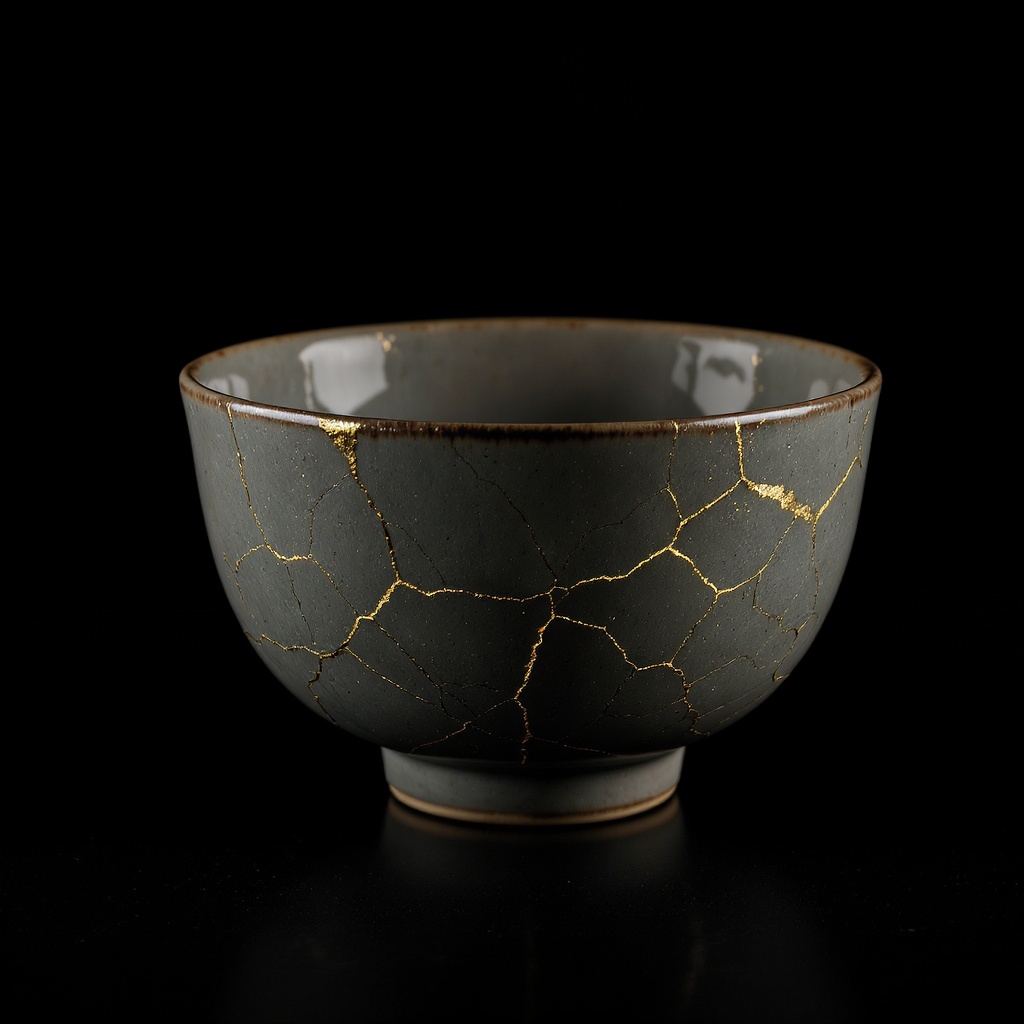
Yoshimasa looked at the bowl with the metal staples and was dissatisfied. He sent it back to Japan, and the craftsmen of Kyoto — the lacquer workers, the goldsmiths, the people who understood that a thing's value was not in its original form but in its history — picked up their instruments and did something different. They mixed lacquer with gold dust and painted it into the cracks. They let the break become the pattern. When they were done, the bowl was more beautiful than it had been before it broke.
That is the origin story of kintsugi — 金継ぎ — the Japanese art of repairing broken pottery with gold. Whether the bowl was actually Yoshimasa's is disputed by historians. The story does not matter for its accuracy. It matters for what it reveals about the instinct behind it: that repair is not the opposite of beauty, that the seam is not a flaw but a feature, that something which has been broken and remade carries more meaning than something which has never been broken at all.
Treasure in Jars of Clay
The Christian tradition has been making this argument for two thousand years. Paul, writing to the church in Corinth, frames it with the kind of directness that cuts through everything else: "We have this treasure in jars of clay, to show that the transcendent power belongs to God and not to us."
The image is deliberate and devastating. The clay is fragile — a single impact ends it. The treasure inside is incommensurate with the container that holds it. The power is not in the jar. The power is what the jar carries. And the jar breaks. The jar always breaks.
Read the whole of 2 Corinthians 4 and you find something harder than the greeting-card version of Christianity: "We are hard pressed on every side, but not crushed; perplexed, but not in despair; persecuted, but not abandoned; struck down, but not destroyed." This is not a promise that the clay will not crack. It is a promise that what is inside the clay will survive the cracking. The cracks are the mechanism by which the power gets demonstrated.
2 Corinthians 4:7 (ESV) has become one of the most quoted verses in Christian culture, usually extracted from its context and softened into something like you are valuable even when you feel broken. Which is true, but it misses the radical premise: you are a jar of clay. You are already broken. That is not a failure state. That is the operating condition.
"You are a jar of clay. You are already broken. That is not a failure state. That is the operating condition."
The Lie of Unbrokenness
Contemporary consumer culture has made an enormous investment in the opposite premise. The lie of unbrokenness is not subtle — it is structural. It is in every filter, every before-and-after photo, every curated social media feed that presents a life without the visible crack. It is in the way we talk about success as if it were a state you arrive at, rather than a process of breaking and reassembling that never ends.
The pressure is not just external. The shame of the crack is one of the most insidious weapons in the enemy's arsenal — it keeps you looking at the flaw instead of at the gold. It makes you believe that the evidence of damage disqualifies you from being useful, from being loved, from being part of the story. The lie says: if people saw the crack, they would leave.
The kintsugi counter-argument is architectural. The gold seam does not hide the crack. The gold seam is the crack, transformed. The seam is not evidence of failure — it is evidence that the bowl survived the breaking and was made whole by something more valuable than the original form.
Drop 001 of Kinshin is a collection built on this argument. Every piece in the drop is built around the theology of the crack — the hoodie, the tee, the crewneck. The gold seam on the sleeve is not a decorative choice. It is a theological statement. It says: I was broken, I was repaired, and the repair is more beautiful than the original form.
The Gospel of Repair
Redemption is not erasure. That is the central claim of the gospel that kintsugi illustrates so precisely. The cross does not remove the evidence of what happened — it makes the evidence of what happened into the very mechanism of salvation. The crack is where grace enters. Not where the light is blocked. Where it enters.
When Paul says "the light and momentary troubles are achieving for us an eternal glory that outweighs them all," he is not minimizing the troubles. He is saying that the repair — the process of being remade — produces something that is more valuable than the original state. The glory that results from the mending outweighs the moment of breaking.
This is a hard thing to believe when you are in the middle of the breaking. It is harder still when the culture around you has no vocabulary for the value of the crack. But kintsugi has held this vocabulary for five hundred years: the break is not the end of the story. The break is the beginning of the most interesting part of the story.
The cultural moment we are in — the particular pressure toward perfection, the particular shame around vulnerability — needs the kintsugi argument more than it knows. The lie of unbrokenness costs people their peace, their relationships, their capacity to be present for what is actually in front of them. The gospel of repair offers something different: that your most visible scars are evidence of your most significant survival.
"Your most visible scars are evidence of your most significant survival."
Wear the Seam
The gold seam on a Kinshin piece is a wearable confession. When you put on the hoodie or the tee or the crewneck, you are making a statement about what you believe about brokenness and repair. You are saying: I have been broken, and I was not discarded. I was remade with something more valuable than the original form.
This is not merch. This is not branding. This is language worn on the body as a practice of remembering — a catechism you reach for in the morning. Every time you put it on, you are being reminded of what the gold seam means: that the crack is the place where the grace came in, and that the grace did not erase the crack but fill it, and that the filled crack is more beautiful than the unbroken surface ever was.
The bowl in the story — the one with the ugly metal staples, rejected by its owner, remade by craftsmen who understood what beauty meant — is the oldest and most precise illustration of what the Christian claim about redemption actually says. The break was not the end. The break was the access point. And what came through the break was not the same as what was there before. It was gold.
The seam is the story.
Wear the seam — Drop 001 →
Restored Hoodie · Gold Seam Tee · Mended Vessel Crewneck. Made to order. Ships in 2–3 weeks.