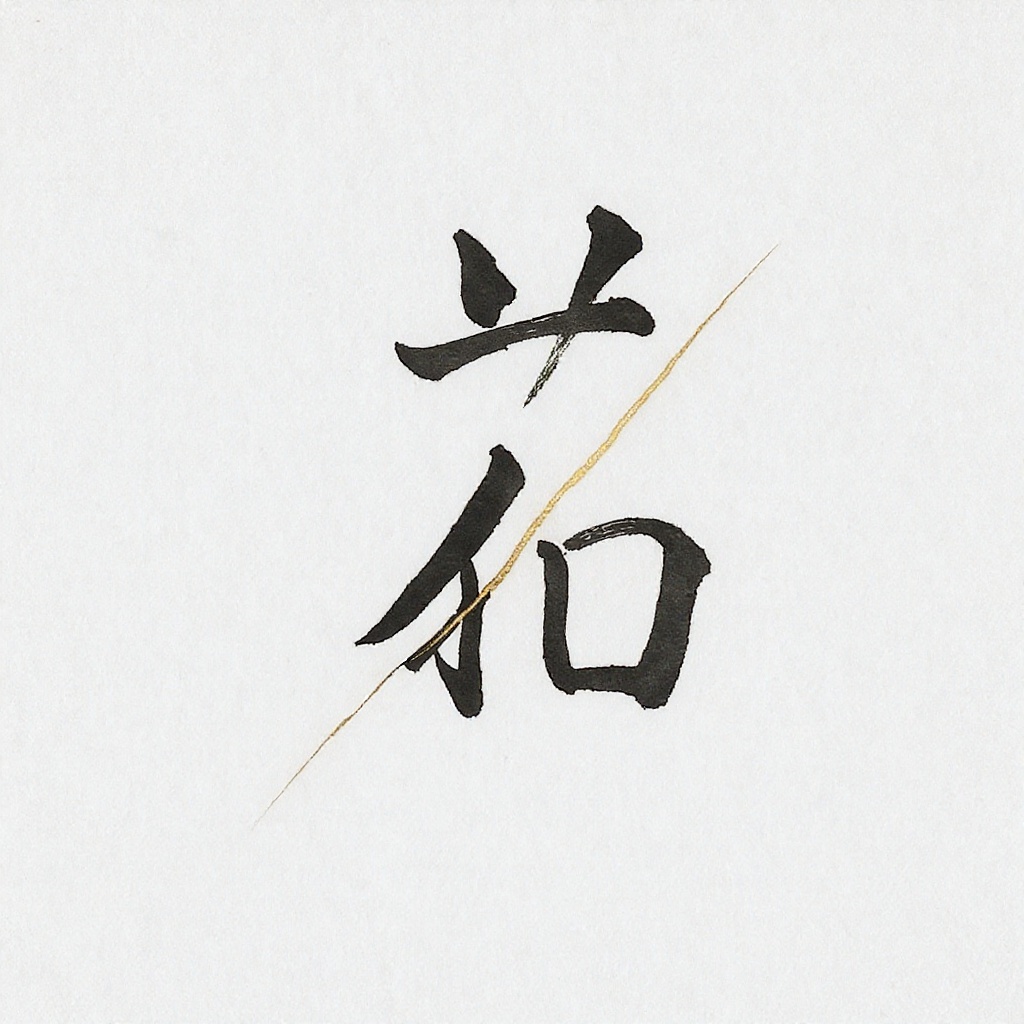
信 / Faith: The Kanji That Holds
The kanji 信 is built from person + word — a person standing by what they say. Why we put this character on the Gold Seam Tee and what it means to wear faith.
The kanji on the Gold Seam Tee is not a logo. It is an argument, compressed into nine strokes of ink.
信 — shin. Faith. Trust. Fidelity. The character is built from two radicals that, placed side by side, form a single claim about what it means to believe. On the left: 亻, the radical form of 人 — person. On the right: 言 — word, speech, the act of saying something out loud. A person standing next to their word. A person who does not walk away from what they said.
That is the entire architecture of faith in this kanji. Not a feeling. Not a warmth in the chest. Not the soft assurance that everything will work out. Faith, in the structural logic of 信, is a character issue. It is the alignment between what you say and where you stand. It is the refusal to leave the room after making the promise.
The earliest forms of 信, traced to bronze-age Chinese script, may have combined 言 with 心 — heart — rather than 人. To speak from the heart. Either way, the architecture holds: faith is not passive. It is a declaration made with the whole self.
What the Greeks Knew
The New Testament was written in Greek, and the Greek word for faith is πίστις — pistis. It appears 243 times. That frequency alone tells you something: the writers could not stop talking about it. But what they meant by it is not quite what the English word "faith" has come to carry.
We have flattened "faith" into something close to "belief without evidence." A leap in the dark. Eyes closed, fingers crossed, hoping the net appears. That is not pistis. That is not even close.
Hebrews 11:1 offers the only formal definition of faith in all of Scripture: "Now faith is the assurance of things hoped for, the conviction of things not seen." The Greek word translated "assurance" is hypostasis — literally, "that which stands under." A foundation. Not a guess. Not a wish. The substance beneath the hope. The word translated "conviction" is elegchos — proof, evidence, the kind of certainty that comes from examining something and finding it to be true.
Faith, in Hebrews, is not the absence of evidence. It is the presence of a different kind of evidence — the kind that comes from knowing the character of the one who made the promise.
This is where 信 and pistis converge. The kanji says: a person standing by their word. The Greek says: confidence in the one who stands. Both locate faith not in the believer's feelings but in the faithfulness of the one being trusted. Both say: faith is not about certainty. Faith is about fidelity.
The writer of Hebrews understood this. The entire eleventh chapter — the great "hall of faith" — is a catalogue not of people who felt certain, but of people who acted as though the promise was real. Abraham left his country. Moses refused the palace. Sarah carried a child she had no biological right to carry. None of them saw the fulfillment. All of them moved toward it anyway. "These all died in faith," the text says, "not having received the things promised, but having seen them and greeted them from afar."
That is the posture of 信. Not seeing the end. Standing by the word anyway.
"Faith is not about certainty. Faith is about fidelity."
The Garment as Confession
There is a practice older than fashion — older than branding, older than logos — of carrying language on the body. Jewish tefillin bind Torah to the arm and the forehead. Buddhist prayer flags carry mantras into the wind. The monks who practiced bokuseki — traces of ink — understood that the words they brushed were not separate from the body that moved the brush.
We are not claiming a tee shirt is tefillin. But we are saying that what you put on your chest is not neutral.
The Gold Seam Tee carries 信 in gold on sumi black. The kanji sits on 280 grams of garment-dyed cotton with Isaiah 61:3 printed on the inside hem: "A crown of beauty instead of ashes, the oil of joy instead of mourning, and a garment of praise instead of a spirit of despair." The gold character on the black field is visible. The scripture is hidden — pressed against the skin, known only to the wearer.
This is not decoration. It is a form of public confession made in fabric.
When you wear a word on your chest, you are doing something that a screen cannot do. You are making a claim with your body. You are saying: this word is mine. I am willing to be seen carrying it. I am willing to be asked about it. The kanji does not explain itself — it demands a conversation. Someone sees 信 and asks what it means, and you get to tell them that faith is not a feeling but a posture. That faith is a person who does not leave the room after making the promise. That the gold on your chest is not aesthetic. It is theological.
Streetwear has always understood the power of the visible word. A brand name across the chest is a declaration of allegiance. A slogan on a hoodie is a condensed worldview. But most of that language is commercial — it declares what you bought, not what you believe. 信 on the Gold Seam Tee operates differently. It does not tell you what the wearer purchased. It tells you what the wearer has committed to carry.
The Gold Seam Between
We named this brand Kinshin — a word we constructed from the Japanese for "gold" and "faith." The gold seam and the faith character are not two separate ideas. They are one idea seen from two angles.
In the first essay, we wrote about kintsugi — the Japanese art of mending broken pottery with gold lacquer. The crack is not hidden. It is honored. The gold seam is the record of what broke and what was made beautiful in the breaking.
Faith is that gold seam.
Not because faith prevents the break. It does not. The people in Hebrews 11 were broken — exiled, imprisoned, sawn in two. Faith did not spare them. What faith did was hold them. It held them in the space between the promise and the fulfillment, between the fracture and the restoration. Faith was the material that filled the crack and refused to let the pieces fall apart.
信 — a person standing by their word. That is what the gold seam does. It stands in the crack. It holds what broke. It says: this was shattered, but the word that was spoken over it — beauty for ashes, joy for mourning, praise for despair — that word has not moved. It is still here. It is still holding.
When you see someone wearing the Gold Seam Tee — walking down the street, the kanji catching light, nine strokes of gold against the darkest black — you are seeing a person who has decided to carry that claim on their body. Not loudly. Not with an explanation. Just the character, the gold, the quiet insistence that faith is not something you feel.
It is something that holds.
Next: 復 / Restoration (coming soon)
The seam is the story.
Wear the seam — Drop 001 →
Restored Hoodie · Gold Seam Tee · Mended Vessel Crewneck. Made to order. Ships in 2–3 weeks.